

Captured by the Sacred
How the cross severed the connection

High in the beautiful blue sky, the sun shines brightly. Green is everywhere. The birds’ songs accompany the gentle breeze, and the sea is barely visible from the top of the hill. This is the best hour to visit a menhir. Megaliths don’t care about our modern time changes. Springing forward and falling back in time don’t exist for them; only the timeless sun and its rhythms do.
Noon is when the sun reaches its summit for the day. At this moment, the waters flowing beneath the huge stone are charged with the peak power of the day. Sunlight and sacred waters, as the ancients knew, are the secret ingredient. Why else would these people take the time to orient standing stones, dolmens, and stone circles to the sun’s annual rhythms?
Solstices and equinoxes are power days, marking not only the sun’s path but something deeper and more profound than a calendar. They mark something divine. This word is not used lightly. It points to an action, a transformation, and a change in body and consciousness that the combination of stone, sun, and water has upon us.
I’ve been studying menhirs for years. My husband and I lead tours in Brittany, the land of megaliths. We visit them year-round, including during the equinoxes and solstices. You wouldn’t think it possible, but the energy of the megaliths is changeable, like the weather. At the equinox, one standing stone may feel active and alive, while another is asleep.
For me, visiting megaliths is a powerful experience. Any trappings of religion that may have been present when it was erected have long since fallen away. All that remains is energy and transformation. Sadly, few know how to tap into the stones’ energy, and even fewer know how to interact with them.
Visiting a menhir is more than a photo opportunity. It can be a spiritual experience. Although they are not natural, divine places like the source of a river or a special mountain peak, their energetic qualities place them in this category. Any belief systems have vanished over time, leaving an experience that transforms.
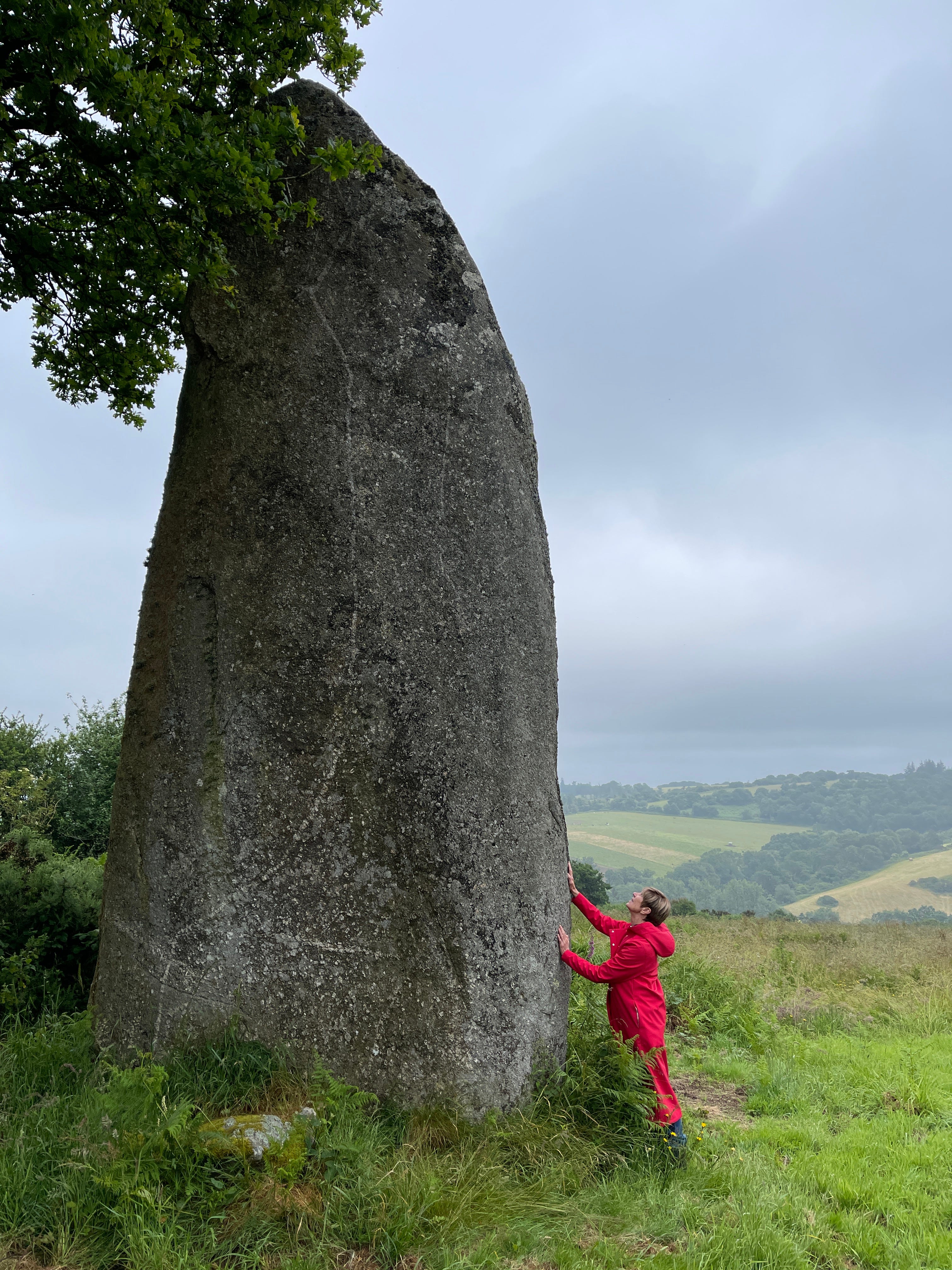
I’ll give an example: two of my favorite menhirs are Kergornec I and II. The first is huge, sitting atop a hill overlooking the countryside. It is surrounded by other large stones and was once part of a vast megalithic complex. I feel the energy shift and rise as we drive up to the giant stone, a signal that we are approaching something very special.
We usually spend some time here because the energy is healing and helps you process things. It primarily works on the lungs and, surprisingly, on grief. I’ve had suppressed emotions, namely grief, bubble up as I sat with the stone. Things like the death of my son, feelings I’ve pushed down deeply because they hurt too much for me to look at, surface, and tears flow.
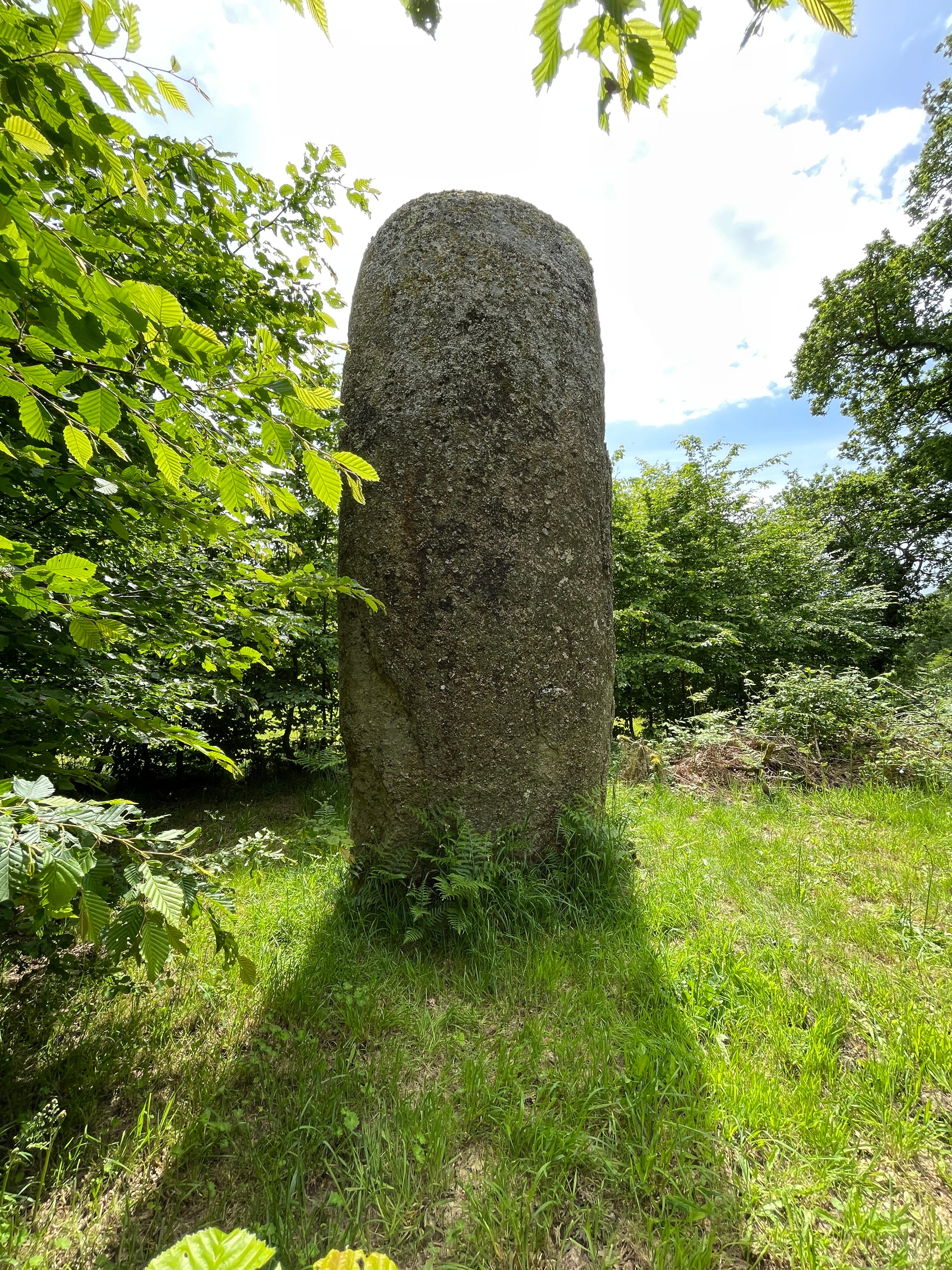
Kergornec II is completely different; it is smaller and hidden away on a farmer’s dirt road. The experience there is amazing; happiness flows everywhere. It takes all the heaviness and sadness that surfaced at the first menhir and transforms them into happy energy. It amazes me to watch these two menhirs consistently do the same thing with our tour groups.
So, what happens when the divine is captured by the sacred?
First, we need to define sacred, because it is different from the divine. Sacred is not an experience that changes a person; instead, it is a separation, a boundary, or a protection of the divine. In other words, it captures the place of the divine and keeps it separate from people. In this way, it can be controlled by religions.
Let’s take a look at what happened at a menhir called St. Uzec in Brittany, France. St. Uzec was erected between 5000 and 2500 BC by Neolithic people. Brittany is a land full of menhirs, allèes couvertes (covered passageways), and stone alignments that have coexisted with the people for thousands of years. The people who lived there descended from the Neolithic peoples. The Iron Age people were called the Osismii and lived in Armorica, the land in front of the sea.
From the 3rd to the 9th century, Celtic Britons migrated from Great Britain to escape Anglo-Saxon invasions. During this period, several Christian missionaries and saints, mostly Welsh, came to the region, spreading Christianity. The Celtic language eventually became the region’s primary language.
The people of Brittany have been Catholic since about the 9th century, when they were further evangelized by Irish missionaries. But the region was always seen as different; it spoke a Celtic dialect, even though it had been a Duchy of France since 1547. Over time, Bretons blended their pagan beliefs with Christian ones, and the cult of the stones was part of that. The people were mostly poor peasants, uneducated, and definitely not part of the French “elite”.
In the 17th century, the French monarchy sought to build a French empire. One territory stood apart from the rest of France: Brittany. Its customs, language, and beliefs differed, and the French empire decided to integrate the region (conquer) through a spiritual conquest, namely, missionary work. Julien Maunoire, a Jesuit missionary who came to be known as the Apostle of Brittany, was the instrument.
In short, during his 44 years of missionary work in Brittany, he transformed the region into the “most” Catholic place in France. Part of his work was to capture the divine, using Brittany’s pagan megaliths as his sword.
The menhir of St. Uzec is a unique example of Maunoire’s handiwork. His missions were attended by thousands of people, and he worked hard to transform the pagan cult of stones into something useful from a Christian perspective.
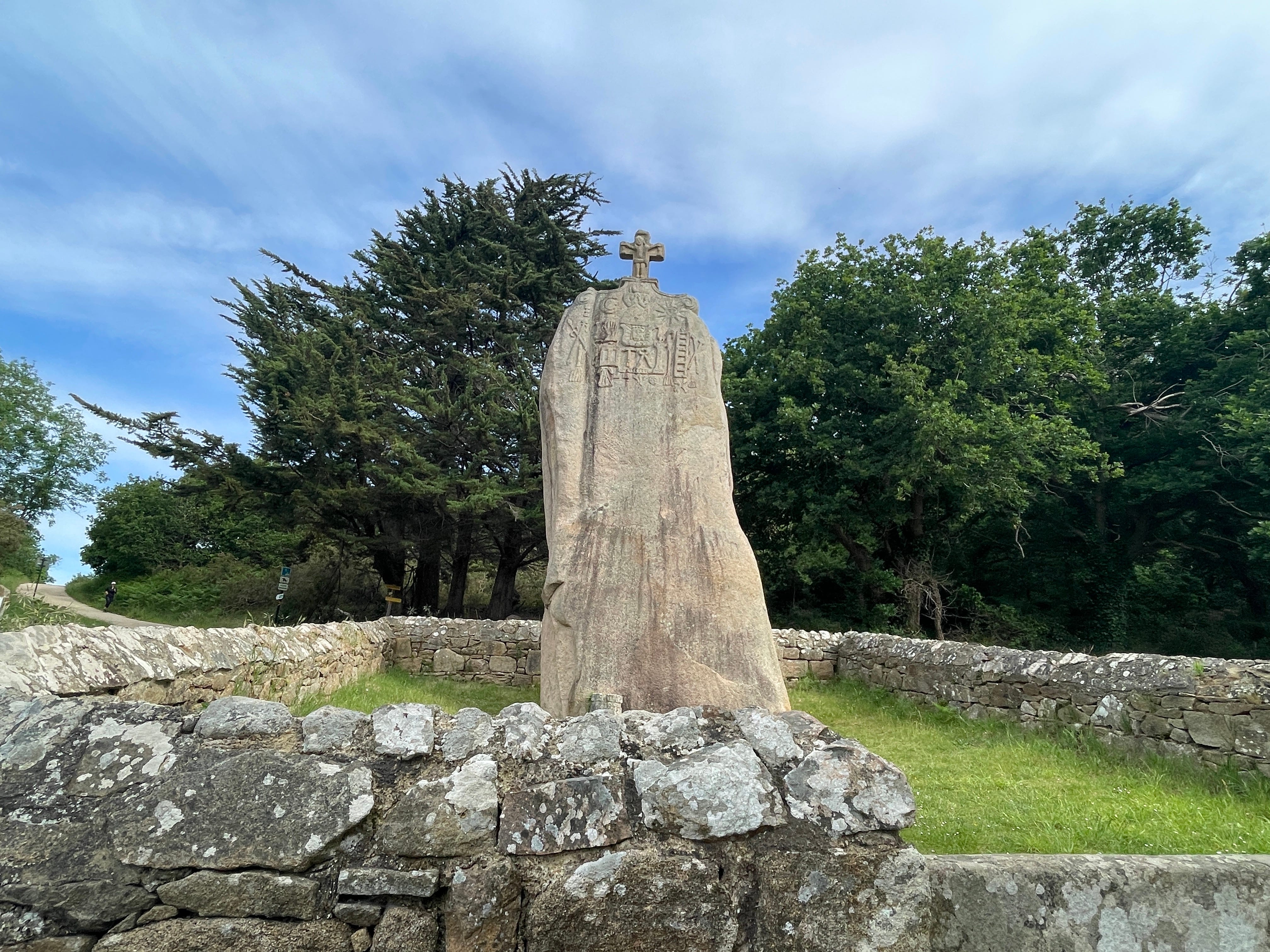
His mission included carving the instruments of Christ’s passion onto the face of the standing stone. Below these carvings was a painting of the crucified Christ. He then placed a stone cross of Christ atop the menhir. A stone basin of holy water, called a bénitier, was set at the foot of the menhir. Finally, Maunoire enclosed the stone within a rectangular stone enclosure.
He captured the divine in this setup on a much deeper level than the physical reveals. Let’s break down how he redirected the menhir’s divine energy. On the surface, he built a church. The altar is the menhir, which holds a privileged position and energy. Holy water sits at the foot of the menhir, and everything is enclosed within a rectangular stone enclosure. Maunoire could even perform rituals inside the “sacred” space, using the menhir as an instrument of the Christian god.
Energetically, the Christianization of the menhir completely rearranged its healing and divine qualities. By placing the cross on top, he really ‘fucked” the standing stone’s energetic qualities. The menhir no longer radiates its original heart-opening energy; it has been capped and only vibrationally rises a little bit. This is the mission’s greatest tragedy: it destroyed the divine and the healing experience the menhir provided to the land, creatures, and humans.
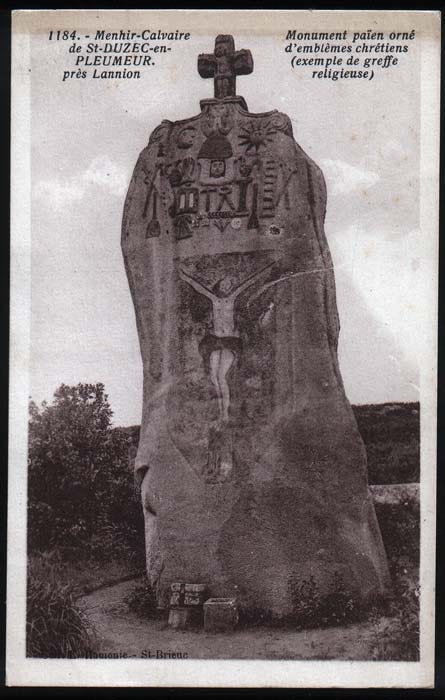
Interestingly, the rectangular enclosure surrounding the stone aligns with the site’s solsticial rectangle. The enclosure is especially fascinating to me in the context of my tradition of the master builders because this rectangle is connected to the sun’s geometry and helps raise a place’s vibration. Builders (including the Church) used the solsticial rectangle to build sacred structures worldwide, including temples, churches, and other sacred places. Here, it could have been placed around the menhir to compensate for the stone’s lost energetic power. Or it was another way to capture the divine and the poor people of Brittany.
To understand what Maunoire really did, you need to understand that a menhir is not only a stone but also a place (or portal) connected to the healing waters flowing beneath it and to the cosmos. All of the stars, constellations, and planets that pass over it have a deep connection with the menhir.
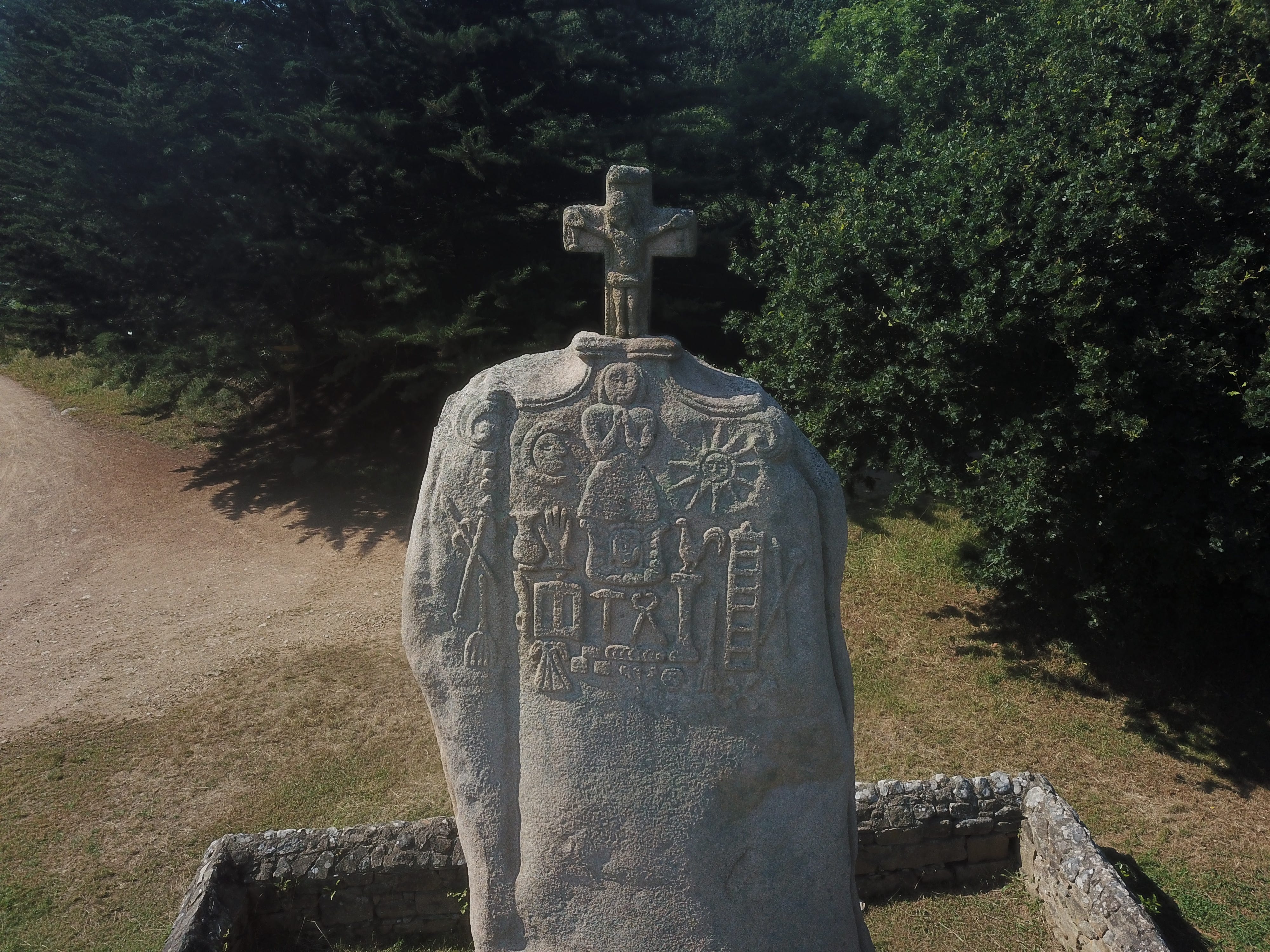
Surprisingly, the factor that plays the biggest role in the tragedy of St. Uzec’s Christianization is the cross at the top. The horizontal arm of the cross effectively severs the menhir’s relationship with the cosmos by blocking communication with it. This manifests as a loss of the normal rise of energy that reaches the sun and cosmos. When a menhir functions properly, there is a connection between the earth, the sun, and the cosmos, an essential part of the transformational experience of the divine.
What happened to the menhir of St Uzec is not merely a story of conversion; it is a story of the perversion of the divine. The natural dialogue between heaven and earth was severed, and in its place, a controlled, contained, and corrupted version was installed.
The difference between divine and sacred is clear; one transforms and the other confines. Once you feel the difference, truly feel the difference with your body, there is no going back. The question becomes: how many other places have we mistaken for sacred that were once alive with the divine?
In the articles to follow, we will journey deeper into these hidden histories. I invite you to become a paid Initiate and join me in a master study of the sacred. Together, we will decode the system behind the stones, exploring how the divine is defined, how sacred structures are composed, and how the intricate dance of solar cycles, earth energies, and sacred solar geometry shapes the power of the world’s sacred sites.